Category Archives: Uncategorized

The Stories We Tell Ourselves

I’ve been thinking a lot recently about my perception of what is happening in my life. I don’t know if it’s a universal human experience, but I think that a lot of us experience life as story. Story imitates life, and so it’s a framework that makes our lives understandable and infuses them with meaning. I think most of the the time the mapping is sort of natural and intuitive. We observe what is happening and it gets mapped onto a story that we understand, and everything resolves rather nicely.

Less frequently, something takes us by surprise. And it’s not JUST unexpected, it’s jarring. A “plot twist” in the story might be a slight surprise, but it still makes sense – it’s consistent with the story we were telling ourselves, it just maybe wasn’t the most obvious telling. But what if you think you’re living one story, but it turns out that you’re actually living another? That’s something else altogether, and it’s extremely jarring, because you have this sudden realization of: “OH. That’s not what’s happening here at all. How did I get that so wrong?”

These past few weeks, I thought I was living one story, but it turned out I was living another. It all sort of came to ahead last weekend/the beginning of this week. It was disorienting, and a bit painful, but in the last few days I’ve been learning a LOT about both myself and other people.

Since this is public and I’m not sure who will read it, I’m going to be vague enough about details that anyone who might would know who the other person involved in is wouldn’t be able to simply know. If you’re here, you probably know who I am, and I’m quite OK with my part of this being known, but I’m not trying to expose anything about another person, I just want to reflect on my part of the experience. So some bits of information about her as I understand her are necessary, but identifiable information will be withheld.

Not too long ago I had an interaction with a woman that felt like a moment of connection. She was previously known to me, though I didn’t know her well. Now, I cannot know how the moment felt to her, but on my side it felt beautiful and deep. She opened up and so did I. That moment endeared her to me, and it felt significant.

Following that, we began to keep in touch through text messages. Suffice to say, we do not live within the immediate proximity of each other. I hoped that maybe it would progress into something, but I couldn’t tell for sure, then one evening after a playful and maybe mildly flirtatious text, she called. That was the next moment that felt significant. Perhaps this will turn into something. That I think is when the story that I’d already begun to tell myself began to solidify in my mind: This was was the story of how when I wasn’t looking for it, I had found the right person for me. Up until this point, it had felt like it was flowing pretty easily, maybe not as quickly as I’d prefer, but it was long distance, after all.

There were more messages, there were a couple more calls, some voice memos, etc. Things were starting to feel a bit ambiguous. On calls felt good and engaged. Replies to messages were nearly always prompt, but, engagement was often low, and threads often died fairly quickly. The ambiguity started to get to me and I wanted clarity, but I also didn’t want to push too hard and break whatever was happening. I preferred to continue to suffer in ambiguity if it meant I felt more assured of an eventual preferred outcome.

I decided the best way for clarity without coming on too strong was to plan a trip to where she lives, let her know I’d be there, and to invite her to come meet up while I would be there if she was free. I thought that surely, with the frequency of contact I was keeping with her that even though I was framing it in a low pressure way she would have to be able to tell I was interested in exploring things with her, and so when she agreed without hesitation I considered that a good sign. The trip was on, and I was going to get clarity – and I was pretty hopeful that clarity would be at least on the positive side of neutral.

The trip started off well, she was pretty communicative in messages and seemed excited as I was on my way there. After spending a bit of the morning on my own after my arrival, we met up for lunch and then did an activity I had planned on – something I actually did want to do but likely would not have gone up there to do if not for wanting to see her – and then generally did a lot of walking around before we were near to her place and it seemed like she might be wanting to call it. It had been an enjoyable day, but it hadn’t leaned romantic at all in the way I had hoped it might – perhaps the answer in itself, but I wasn’t ready to accept that yet. And in any case, it didn’t tell me NO interest, it only told me there wasn’t positive interest. So, I managed to convince her to hang out a bit longer and have a drink. We talked for a long while, but the content of the conversation seemed to be saying “no interest”. As disappointed as it made me, I kind of accepted it at least for that moment in time.

The next day we met up again for awhile and by the time I left between that day and thinking back on our earlier interactions I just really started to think that the way she acted FELT like she was interested but that something was holding her back. I guess I should say that part of the conversation the preceding night had been her talking about a belief that to her mind for a relationship to have potential romantic success she needs to have the feeling of love IMMEDIATELY, like an instant spark. And so this started to make sense to me, she does have some interest, but the spark wasn’t big enough and she has this internal rule that says no so she’s holding herself back. I didn’t want to end the trip on an awkward note and so since I was out of time I just decided to wait until I was back home to just be up front about it and take the risk.

I let a full day of rest in between just to let things breathe and because I was also kind of exhausted after the trip, and I sent a message saying how I felt. It was something I pondered over the wording of for awhile because it felt like it mattered. Unfortunately, the response I got felt dismissive, and essentially informed me that a lot of guys misread her. She didn’t directly say that I did, but, that was the implication. The other thing was, the reply came fast… like, just a few minutes after I sent it, and probably less than a minute from the time she saw it. It was clearly reactive and not thoughtful. Needless to say, both of those things hurt. I sent one message back hoping to prompt her to reply with more thought, but again I got a fast reactive reply.

I spent the rest of that day feeling pretty raw. I was really frustrated with her for being dismissive of my message, in which I had tried to succinctly tell her my experience of the preceding weeks and that I’d like to see how things developed, and for just kind of being flippant in her response, it made me feel like I didn’t matter to her at all, like, even as a friend. The next day was a little better, and then the next I found myself starting to read about Attachment Theory and making discoveries about both myself and her and why things happened like they did. As I started to understand her my irritation and frustration at her turned into empathy, because I don’t think the way she responded was really a choice that she made, it was an innate self-protection strategy. And the ways that what I could have done things but didn’t earlier in the story to try to get clarity weren’t not done because I chose not to do them, but because of my own innate self-protection strategy.

It’s still very new to me, but Attachment Theory is really interesting and revelatory to me of both my own self and other people. Like as I think through times in the past where people behaved in ways that were confusing to me I can see which attachment style they operate out of. The main ones are Secure (something like 50% of people), Anxious-Preoccupied (something like 20% of people, including me), and Avoidant (Something like 25% of people, including her). Secure attachment is essentially healthy attachment, the others aren’t pathological, but essentially are behavioral strategies to protect the person in the process of attachment. They are generally learned early in life, often in regard to relationships with parents, but there are other factors as well. Anxious-Preoccupied and Avoidant attachment styles serve a purpose when they are learned, but then when they are no longer needed they essentially start to do the wrong job really well and cause you strife. Then, in particular a Anxious-Preoccupied paired with an Avoidant gets into a push-pull dynamic that can be like the Anxious-Preoccupied person’s kryptonite. The Avoidant thrives in ambiguity, the Anxious person can’t stand it and starts to over-invest thinking it will bring clarity, and the Avoidant distances themselves from anything resembling obligation.

But, keep in mind, both the Anxious and the Avoidant WANT connection, but Anxious people obsess over it to the point they cause it harm and Avoidant people are wanting to avoid dependence and obligation, so if things start to deepen they create distance. Anxious Attachers are attachment-maximizers and Avoidant Attachers are attachment-minimizers. That dynamic explains why I felt connection – connection was there. But whereas I wanted to maximize it and push it forward, she wanted to minimize it and keep it contained. Unfortunately for myself in this instance, her innate attachment strategy is warmth and depth to create a moment of connection without structure for continuity. I respond to the warmth, depth, and intensity with an assumption that it is building a structure for continuity, and that mismatch is where things went awry. She could go deep, but she couldn’t stay. And I wanted her to stay.

This attachment framework has also been helping me sort out some past misfires, and sort of recognize things I’ve considered off interactions with friends, etc for what they are, which are basically just attachment strategies and coping mechanisms related to them. It’s also really helpful to understand that the way that I react to things isn’t super crazy and bizarre, but in fact a lot of people out there react the exact same way. And also that when people act in ways that seem strange to me that maybe it doesn’t mean some bad thing like I might assume, but just that they are acting in a manner that’s consistent with a lot of OTHER people, who don’t act in the way that I do.

Perhaps most importantly, I have a couple action items I can work on. First is to work on growth. Now that I recognize anxious attachment in myself, I can work on learning to change it toward secure attachment. The anxious tendencies actually make me kind of miserable and don’t serve me, so it’s (past) time to train myself out of them. And the second is, in the meantime, watch out for avoidants and DON’T let myself get drawn in by them – because that just creates misery for me. After some growth, I might be able to deal with them, but for now, those people just aren’t for me.


Authenticity

I’ve heard it said that the highest value of a Millennial is authenticity. I think that’s probably a generally true statement. Loathe as I am to say it, I myself fall into the Millennial category, although I always argue for the Xennial micro generation between Gen X and Millennials. Alas, spellcheck doesn’t recognize Xennial as a word, so that’s still an uphill battle I suppose. Regardless, whatever it is that makes Millennials so value authenticity… I’ve definitely got it.

There’s nothing wrong with authenticity of course. Being true to yourself and saying the things that you truly believe or feel can be perfectly admirable. When someone is being obviously inauthentic it can be a painfully cringeworthy experience. But that said, being authentic is not the best thing that a person can be.

In fact, placing authenticity as the highest standard leads to settling for being less than one could be. One might say he is lazy. It’s not that he wants to be, but that’s just who he is. He can’t change it. He’s just being authentic about it. Or perhaps out of shape. Or no good at “x”. Or overly blunt. Or any number of things. Authenticity as the HIGHEST good simply leads to total acceptance of whatever you are and eschews any impulse that one might have to change. Or with a matter of beliefs, a total acceptance of what you see to be true without any impulse to confirm it or examine other opinions.

I have no intention of putting forth an entire hierarchy of values here, but I will posit what the better highest value is: Truth. If you hold a false belief authentically, it does nothing good for you. In fact, it might harm you, or prevent you from realizing your potential at the very least.

When I watch the videos of the sermons at the church I attended prior to becoming Orthodox, it reminds me of who I was then. I was still the person who put authenticity as the highest good. That was what I liked about the church, the authenticity of it. I’d wager that’s what most of the people attending there like about it as well. Before I say anything negative, I do want to say that I think they for sure do a lot of good there. I’m sure they’re meeting a lot of people where they are. I was glad to be there for the time I was. But, when I watch the videos now what I really think is… this isn’t Church. That’ not me challenging their salvation or saying they’re not Christians, it’s just me saying… they’re not having a Church service. Much of the time it doesn’t even really strike me as say, spiritual teaching. The vibe I get is “self help”, with a smattering of Bible verses here and there. I’m not against what they’re doing (though I may disagree with specific things said from time to time), but what I really think is that they’re too concerned with being authentic and not concerned enough with finding Truth (God). Because of the misaligned focus, I think it makes the people there fall short of what they could have. But thank God that they do have some part of the Truth.

I doubt anyone there would both find their way to this and know who I am to know that I’m talking about them, but if you did – know that I love you and pray for you, and I value what I got in my time there. May you grow deeper in the knowledge and love of God!

Ascetic

“If there is no element of asceticism in our lives, if we give free rein to the desires of the flesh (taking care of course to keep within the limits of what seems permissible to the world), we shall find it hard to train for the service of Christ. When the flesh is satisfied it is hard to pray with cheerfulness or to devote oneself to a life of service which calls for much self-renunciation.” 

-Dietrich Bonhoeffer

I converted to Orthodoxy just a few months prior to the start of the Coronavirus Pandemic. Of course, I had been inquiring for about a year before that, and in that time had given thought to the idea of asceticism. Coming from a Protestant Christian background it is somewhat of a foreign idea. Not completely so, but, still, there is not much emphasis placed upon it in Protestantism. It’s mostly something you see your “overzealous” friends do.

In the Protestant world it looks something like… giving up TV for a month. Or going on a juice fast for some period of time. Or maybe just skipping a meal. Now, I’m not knocking those things. That thing I said about overzealous friends? That’s how I felt about it years ago. I think those people were onto something. But, there’s no structure of asceticism in the Protestant world. There’s nothing like: Fast on Wednesdays and Fridays, unless it’s during a feast week. No one expects you to do it, I guess is what I’m really getting at here.

So, obviously, as I just mentioned, in Orthodoxy you have that basic weekly fast, where MOST weeks of the year, the “rule” is that you should fast on Wednesday and Friday. No, Protestant friends, it’s not a rule in the sense of.. if you don’t fast those days you are definitely going straight to Hell. But, it’s a rule because it is for the benefit of your soul.

I had some starts and stops with fasting early on, and more recently I just haven’t really tried at all, until today. Today I kept the fast. And I intend to do it again on Friday. I want to get to a point where I’ll be able to make a real go of keeping it for all of Advent.

Why the sudden interest in doing so? Well, because I recently started seeing mentioned in various places the idea of being better than you were the day before. I think in at least one place it was a clip of Jordan Petersen, suggesting that you should never compare yourself to other people, because you have no idea what their situation is, but you CAN compare yourself to yourself. So just be a little better tomorrow than you were today. That’s the thought I really needed to hear.

Lately I’ve gotten pretty lazy about things. And if I’m honest, being lazy has been a big problem for me much of my life. It’s not that I’m ALWAYS lazy, or that I’m lazy about everything… but I can be lazy about a lot of things. So that’s meant I’ve not really been exercising for the last several months, I haven’t been eating well the last several months, I haven’t really been praying or reading the Bible as much as I should the last several months… and also I haven’t been writing like I should. I’ve NEVER written like I should. I like it, but as soon as I start to feel like I’ve got a bit of writer’s block, I just stop trying. But I want to break through that. That’s why the new blogs lately. If I don’t keep up with them then you’ll know that I failed.

I feel like a modern secular asceticism is the idea of a diet. Limiting your food choices so as to lose weight instead of just eating whatever you fancy at the time. It may not perfectly meet the requirements, but it’s something close. When I started out with the idea of fasting I thought something like… “But my food is already limited by my diet, and then this is going to cut out the primary thing I’m allowed to eat: meat.” While that’s true, it’s not like it’s impossible to do both. After all, there are people who do vegan keto as their whole lifestyle, and they manage to survive. While I only need to fast on Wednesday and Friday I think I’ll be able to get by just figuring things out on my own, but by the time Advent rolls around, I will for sure be checking out some vegan keto recipes.

I’ve also started using a stupid little iPhone app I bought years ago that lets you earn “experience points” for doing tasks that you define for yourself. Strangely it is a little bit motivating to be able to go in there and knock them out after I finish something.

So a few days in, things are going pretty well. I’m not much better than I was a few days ago, but I think maybe marginally so.

Decay

Actually I am a Christian, and indeed a Roman Catholic, so that I do not expect ‘history’ to be anything but a ‘long defeat’— though it contains (and in legend may contain more clearly and movingly) some samples or glimpses of final victory.

J.R.R. Tolkien

The most effective way to destroy people is to deny and obliterate their own understanding of their history.

George Orwell

Perception is more important than reality. If someone perceives something to be true, it is more important than if it is in fact true.

Ivanka Trump

The only idea they have ever manifested as to what is a government of consent, is this–that it is one to which everybody must consent, or be shot.

Lysander Spooner

JRR Tolkien had a notion of something called “the long defeat”. If you’ve read The Lord of the Rings, you’ve seen this exemplified (to a much lesser degree if you’ve only seen the films, but it’s there). You get the sense that the greatest days are behind these people – the world is on the decline. It can also be looked at on the individual scale – one’s whole life is a long defeat. Fight as hard as you can, you are going to die eventually. Yet it is a fight worth fighting.

You may recall that the end of Lord of the Rings was not quite as depressing as all that, which is true, but there’s a reason for that, which I’ll get to, eventually.

The national dialogue (if you can call it dialogue) seems to be pushing everyone to choose a side. Whose side am I on? I feel it’s best summed up by Treebeard in the video above.

This is a difficult time, and I have remained largely silent on my thoughts. I’ve occasionally posted links or videos onto Facebook that I think are interesting in some way. Despite remaining what I felt was fairly neutral, at least one of those generated some volatile pushback – from someone that I genuinely like as a person – and that as far as I know likes me. Why the pushback? Well, I think simply that it went against his side caused me to be lumped into the worst of the “other” side. He did apologize for the reaction, and I absolutely do not hold it against him, but I mention it here because I think it’s an important example and is something that happens a lot – and it would happen more if I was more vocal. I expect that if anyone takes the trouble to read this, I am going to get some negative reactions here.

People oversimplify. Life is complicated. History is complicated. How we got to where we are now is very complex, and how we get out of it isn’t straight forward. It would be helpful if we could have a straight forward conversation… but we can’t. Why can’t we? Because amidst people who have honest and true concerns, we have many people being disingenuous in what they are trying to do.

We are making terrible assumptions.
We are making the wrong diagnoses.
We are applying bad solutions.

The very notion of “sides” here is a major problem. In one sense, we are all individuals, and as such there are so many sides so as to make the notion of sides a useless one. On the other, we are all Americans, and beyond that, all humans created in the image of God, and ought to be united in our desire for the good of each other in that way. Even if we disagree with what the solutions are, we should acknowledge that we are part of the same team and treat each other charitably. Good people can disagree with me, and they should be able to still see me as a good person, and I them.

I fear that will not be the case though. I fear that in writing these posts I am going to lose friends who, though I believe they are misguided, I believe are good people. Why will I lose them? Well, I fear they will think me not a good person – because they have embraced ideology that says that good people cannot disagree with them, ergo, I must not be a good person.

What I see right now is a society in decay. Now, please understand that I get that not every individual’s experience of our society is the same, but judging America against America’s entire history, it seems to me that it is objectively true that overall the BEST version of America is, essentially now. I say essentially because I think there’s an argument to be made that in the recent past we reached the pinnacle and started a decline. I would in fact make that argument myself. Can I pinpoint exactly when we reached that pinnacle? Not really. I’d bet a lot of people would say Trump’s election, but, I don’t think that’s right. But it’s really difficult to say, because I could point to things and say “this is something that is contributing to the decline, and it started at X point”, but that doesn’t mean we were IN decline when that thing originated. I would say Trump’s election was more a result of people sensing the decay than it was anything else. As Jordan Peterson has imagined aloud on a few occasions, many people simply said “to hell with it,” and voted for Trump.

It’s worth noting that apart from a handful of edits, everything above this point was written months ago. If you’re reading this near to this post, you are very aware that Biden very recently entered the office of the Presidency. Perhaps you think this is going to turn things around. I am certain that you’re wrong. If anything, things have only gotten worse from when I began writing this post. I never came back to it until now because I doubt that I can really impact anyone’s opinion, and I fear losing a friend. But ultimately I have to say what I think. So I’ll just pretend that since I’m not going to post this on Facebook, and within 24 hours from now my Facebook account will be deleted, that means that no one is going to read this anyway.

Things are not getting better. Censorship is increasing. Even if you are sure that someone is wrong, they have the right to be wrong, and to try to convince other people of their ideas. I think people who believe the earth is flat, or that the moon landings were faked, are crazy, but, I also don’t think they should be silenced. I don’t really make any effort to follow the Q stuff – certainly a lot of what people have told me about it sounds crazy, but again, they have the right to believe it and say it.

Silencing voices is not how we’re going to heal anything – that’s how you’re going to drive people to extremism. Big tech colluding to nuke Parler is bad news, no matter how you feel about Parler. Twitter is obvious in their bias in how they enforce rules, and they allow abhorrent things to remain on their network while banning Trump for fairly innocuous tweets. Now people in Congress are urging the FBI to investigate Parler and for YouTube to increase censorship. The Russians continue to be the big bad. Oooh… Scary Russians are coming to get you, so we must give up freedom of speech.

I’ll be honest, things are starting to feel pretty hopeless. Ideological differences with fellow Americans are getting to the point where I almost feel like they are irreconcilable. And if that is truly the case, then division is inevitable. Does that mean civil war? I don’t know, maybe. I guess it depends on whether or not the powers that be allow for a split to happen peacefully or not.

But perhaps I’m wrong. Perhaps we’ll be saved via eucatastrophe. Our doom is certainly quite probable, and feels quite immanent – but I will not say some sudden and unexpected turn of events could not save us.

If you think that Trump was a tyrant, I can only say that he was the most ineffective tyrant in history. If you think Biden is going to be a great President, I invite you to wait and see what the reality turns out to be. He’s already admitted he’s not going to do any better than Trump on Covid… not to mention implementing his mask mandate and then failing to abide by it only hours later. Imagine the media reaction if Trump had done such a thing. I don’t argue that Trump was some sort of savior, only that he was not uniquely terrible – and certainly not a tyrant or fascist.

I have a feeling things are going to get interesting… if it is to be a defeat, may it be long indeed… and truly I hope for some unexpected salvation to come.

Dark Dreams

I don’t typically remember my dreams very well. Usually if I write it down within an hour of waking up I can get it all out and then I can remind myself of it later. However, I don’t generally have time to do that in the morning unless it were to occur on the weekend, so unless it seemed to have significance to me or was just exceptionally bizarre, I probably wouldn’t do it.

That said, last night I woke up several times following dreams that I found to be somewhat disturbing. To set the stage a little bit, a couple of weeks ago I had received some icons that I ordered. As not everyone reading this is going to be familiar with what that is (though I’m not going to share this one on Facebook), google “Orthodox icons” and you can get an idea. Essentially they are images that represent Christ, or saints, or specific events in church history. Within Orthodoxy, they are used to show veneration to those depicted. I had ordered 4 of them. What they are is of no particular consequence in regard to the dream, so, I won’t get into that here. What I suppose is relevant is that I don’t have a proper icon corner at this stage… for the moment the four icons are laying on an end table in my living room. I’m in a small apartment and so the difference between my living room and my “bedroom” is just some dividers that I put up.

I had the same basic dream with slight differences 3 different times, each time waking me up in the end. The first dream was significant in that it felt the most real. In the dream, I got out of bed and went out by where the end table with the icons is. Strangely, they had all fallen onto the floor. I was concerned and went to pick them up, and as I picked them up I found that they had been defaced – a strange oddity in this first dream was that it was as if the images had previously been mounted on and were removed, leaving just a solid color beneath, and then in the place of the image were placed words – I can remember an image in the first dream, just a silver background and the words “Fallen Angel” written on it. I could feel like I was being pressured to show veneration, and I refused, and, I think it was at that moment I started to suspect I was dreaming, because I remembered something my priest had told me in a catechism class, that when something appears to you in a dream you should cross yourself. It was a passing comment about something we were discussing so I can remember the full context, but in this case I crossed myself 3 times in the dream and verbally refused, saying that I serve Christ. I woke up at this point, and did the same in wakefulness before going back to sleep. As an aside, I had no sense of any presence while I was awake.

The second time was much the same. It felt real at first but I recognized it much more quickly as I remembered the previous dream. The icons were again on the floor, but this time it was more like they had been painted over. Instead of solid colors with text, there were images – Just like in the first dream, the only one I really got a good look at is the one that I picked up. I just remember it was a somewhat grotesque figure, a dark brown being the predominant color. I also remember that there was a name written on it, which I took to be the name of the demon that it represented. I actually actively tried to not remember the name. At the time it seemed like remembering the name would perhaps be detrimental in some way. All I remember about it is that it started with an “e”. This time I woke up as I began to cross myself in the dream, and again in wakefulness I crossed myself 3 times and refused again.

The third time I recognized it as a dream the moment I saw the icons on the floor. This was the most different because while I still felt that pressure in the dream to venerate I didn’t pick up any of the icons and so I don’t remember what they looked like this time. But as before, I awoke, crossed myself 3 times, and refused.

I did have another odd dream following this, but it wasn’t quite the same. It was pretty much about me going to church and finding myself arriving there improperly dressed and I had accidentally brought the wrong clothes with me. The three dreams that woke me up really struck me as being rather dark and disturbing – this last one seemed more like just a bizarre dream.

When I got out of bed this morning, I decided to try to google to see if I could find anything about someone else having a similar dream. While there’s plenty of things written about people who either have or believe they have had dreams with demonic influences in them, I didn’t see anything in regard to icons specifically. That said, it’s not like I did extensive research, I looked at a few different results that came up.

One of the things that I found was the idea of “hell icons”. According to the few things I’ve read about them, it sounds like it’s unlikely they ever actually existed, but the legend goes that these were icons where a beneath the image of Christ, or the Theotokos, or a saint, would be an image of Satan, or a demon. You can read about it here: https://russianicon.com/mystery-russian-icon-art-hell-icons/

I’m not sure if I think there was a true demonic presence in my dream or not. I’ve watched a couple movies recently that could have theoretically influence my subconscious in some way… but I don’t know where this idea of icons being altered into demonic icons could have come from if that were the case. I also earlier in the day yesterday had said to myself that I really needed to make a decision about what I was going to do in regard to a sin that I’ve struggled with for some time. That being because if I’m really going to join the Orthodox Church, and I do intend to, then I want it to be because I am serious about it, and about becoming like God.

Open to hearing any thoughts someone reading this might have.

Malcolm

Earlier today, I said goodbye to a good friend. Back in May of 2008 I drove out to the northwestern part of Ohio to pick up Malcolm, a ~2 month old Alaskan Malamute puppy.

It was a very different time in my life as compared to now. I was accompanied on that trip by my then wife. I don’t remember a lot of the details of the trip, but I know it was a long day (we drove out and back in a single day) and that it was the first time I used a newly acquired GPS (this was before they were in every phone – prior to that it was MapQuest). The lady we bought him from was very kind and helpful, and she introduced us to his parents while we were there.

On the way back home, we had to stop in Breezewood because Malcolm had peed on her. She got cleaned up and we managed to get back before too late in the evening. He met my parents’ dog, Jean Claude, who he was already bigger then, but Jean Claude scared him so badly he peed then too. But the two of them came to be good friends – and it was kind of funny to watch them pal around together given the disparity in their sizes.

Malcolm has been there through a lot of stages of my life, including the hardest one, when the divorce happened. In terms of its life-altering nature and the emotional pain involved, it still ranks at #1 for me. But Malcolm was there to keep me company, and for me to talk to, even if he couldn’t talk back. He was a great dog, and a good friend.

I moved away for a time, first to NZ for a year, and then to Los Angeles for a few years. I didn’t want to leave him behind, but I knew I couldn’t bring him with me those places. At the time when I was going to NZ I thought I might be saying goodbye forever, but thankfully my parents decided to keep him there. If not by the time I got back from NZ, certainly by the time I moved back for LA, Malcolm had been solidified as my Mom’s dog, but he never stopped being my buddy.

He had a really strong will. Back when he was crated, he used to be able to escape from it all the time, often just by forcing himself through what seemed to be an impossibly small space. He’d do the same to get out of the fence and go on adventures through the neighborhood. I remember many times going after him trying to get him back home. The frequency diminished, but he never really gave up on that. Even just a few months ago with his bad leg he got out, and unfortunately got stuck back in a creek – fortunately he was found and brought back in. It would be the last time he got out, but really only because he wasn’t let out in the yard by himself anymore. I’m sure he wanted to go exploring just as badly.

It’s not been that long since I had to say goodbye to a dog. There are a lot of similar feelings, but, there’s a lot that is different as well. Yuna was just a puppy – it was such an unexpected thing to happen. I didn’t have anywhere near the volume of memories with her that I have with Malcolm. She wasn’t really there for me through much of anything. But I don’t think it hit me any less hard than this hits me.

The one thing that makes this easier than it otherwise might be is that we knew it was coming. Probably a little more than a year and a half ago, Malcolm was diagnosed with a form of bone cancer. We were told he had maybe 6 months. He made it so much longer than anyone thought, no doubt in part thanks to all the things my Mom did for him to take care of him and keep him in good health. I think the other part was just that he had that strong will. He didn’t let it stop him.

Finally, a few days ago, that strong will stopped being enough, and there weren’t any more options to ward off the effects of the cancer. He wasn’t able to get up or walk anymore, and as it reached the point that he seemed to be both in pain and incapable of living a normal life anymore, my Mom made the decision to take him to the vet to be put to sleep.

I met them over there and sat with Malcolm for the last time. First as he was in the back of the van I whispered into his ear something that I often did: “I love you. Youse a good boy.” After a few minutes we brought him inside.

As much as I miss him and will miss him, knowing the state he was in I know that it was the right decision. My mom and I sat and pet him as he fell asleep from the sedative they gave him. He fought it off a long time, and as they were getting ready to give him the injection, he still woke up again. Even with his body completely broken and in the pain he was in he still kept trying to be there. I sat and held his paw and softly pet him as he breathed his last, and kissed his nose one last time as I stood up to leave.

https://blogs.ancientfaith.com/glory2godforallthings/2012/05/02/all-dogs-go-to-heaven/

Catechumen

Crazy that I haven’t posted anything here since near the end of June. I’ve been putting off writing a few different post ideas, but I didn’t realize it had been that long! Some of the ideas I had are still going to be put off a bit more, because I want to write about something else today.

What is that something else? I’m glad you asked.

Back around the time when I last updated this, I was just finishing up with the last few Sundays serving at Collective Church. Since I didn’t really talk to anyone other than those necessary about my departure because I didn’t want to make a big deal out of it… I guess I can start this off talking about the why of it, in case anyone from Collective reads this (I’m always surprised to find out people actually read these things).

After months of reading about the Orthodox Church, I decided to visit one. So, around the end of May, I visited a Western Rite Antiochian Orthodox parish. I was intrigued enough that I continued to attend every other week. After that first visit, I reflected on it for a week before deciding I would ask for a leave from being on the production team – I wasn’t sure if it would be temporary or permanent. I visited a couple other churches and ultimately found that I really felt comfortable at one in Potomac – part of the American Carpatho-Russian Diocese – called Holy Resurrection Orthodox Church.

I’ve been to Holy Resurrection 5 or 6 times now, and recently made the decision to make it my home parish. Even before this, I had already decided that I want to start Catechumen classes to being the process of being received into the Orthodox Church. However, deciding on a home parish needed to be done first. About a week ago, I spoke with the priest about starting those classes and they should be beginning in the next week or so.

I look forward to beginning them – I’ve done a lot of reading but I’m sure I will continue to have more questions and I’ll get things answered that I didn’t even know that I should be asking.

What I found most interesting as I began researching and visiting is that in many regards I already agreed with a lot of Orthodox theology in many ways – by which I mean that when I read it I sort of thought – “you know, I’ve felt that way about this for a long time” – particularly their theology on original sin differs in a significant way from the western church (read: Catholics and Protestants both). I still have so much to learn regarding Saints and the Church fathers – but I feel so much more connected to the history than I ever did before.

I guess some folks might be wondering why I would want to become Orthodox. Perhaps even simply “What made you decide you weren’t happy at Collective?”. The answer to that question is… nothing. I didn’t really seek out something different so much, I just got there through looking at historical Christianity – searching for things about the early church, etc. I became enthralled with it, and I was also surprised by how easily some of the things I initially felt that I disagreed with I was convinced on.

So – I’m not sure how long I have to go to truly become Orthodox – but that is what I’m on the path toward now. And I’m pretty excited about it.

The Modern Heresy


“There can be only one permanent revolution — a moral one; the regeneration of the inner man. How is this revolution to take place? Nobody knows how it will take place in humanity, but every man feels it clearly in himself. And yet in our world everybody thinks of changing humanity, and nobody thinks of changing himself.”
-Leo Tolstoy

“He who was the Son of God became the Son of man, that man … might become the son of God.”

-Iraneus of Lyons

“The Word was made man in order that we might be made divine.”

-Athanasius of Alexandria

“The terrible thing, the almost impossible thing, is to hand over your whole self — all your wishes and precautions — to Christ. But it is far easier than what we are all trying to do instead. For what we are trying to do is to remain what we call ‘ourselves’.”
-C.S. Lewis

A few months back (I think, it can be hard to keep track of time) I decided to take a break from following politics. Now, I still look at the news sometimes, and might catch some political stories here and there, but what this really means is that I stopped listening to the political podcasts that I had been listening to. Also, I severely cut back on watching such youtube videos (The intent was really to not watch those at all, but, I confess that sometimes I find something enticing and watch it). The result of this was actually what I pretty much figured it would be: No real net loss to me in any area and I generally feel less frustration and probably am generally happier than I otherwise would be.

Much of what gets thrown under the political sphere these days though would probably be more correctly identified as culture. It only becomes political if you decide that government should have some sort of role in everything. A character in a game I was playing the other day said “Everything is political”. While I disagree with the statement myself, I think there are a lot of people out there who hold that to be true.

The Tolstoy quote I referenced up top has a shorter, punchier variant that is perhaps more popular: “Everyone thinks to change the world, but no one thinks to change himself.” This is a big part of what I want to talk about here. So much of how we engage with each other in the modern world is through trying to change other people to fit into our idea of what a better world would be. Everything becomes political because the government becomes a tool to enforce that change. Most times when people propose a law or a regulation, it’s to bring the world more into line with what they believe would be better.

I think that there is at least one major problem with this line of thinking. That is, you could very possibly be wrong about what would be better, or good. Do you really know what all the possible consequences of enacting a certain law would be? Want to get guns off the streets? How about a gun buyback program? (Follow that link and tell me if you still think it’s a good idea.) The truth is that as people we tend to oversimplify issues and don’t appreciate the complexity of the problems that we are dealing with. Changing the big picture is extremely difficult, because there are so many small details and we are incapable of seeing how they all interact.

What really gets to me though is the way in which many Christians respond to the question of how to redeem the world (to use Christian language). I think that many or perhaps most Christians put too much stock in the government’s role in this, but I am particularly disturbed by those I will call “social justice Christians.” To be clear, I am not making any judgments as to whether or not someone is a Christian – but I do believe that by engaging the world on the idea that we can achieve perfect justice, or something approximating it, via government might, is heretical to the very essence of Christianity. The world can only, and will only, be redeemed by God, through the incarnation. We should not think we can pass that role on to the government.

Western thought is really closely associated the the idea of individualism. I think individualism is a really important concept and that we’ve made a lot of great developments based on a Western understanding of it, however, I will say that we’ve perhaps overemphasized the individual by too often neglecting the communal. On this point, anyone reading this who has been disagreeing with my up until now has probably found something we can agree on. By and large, we do not value our communities as much as we should – and we often neglect to really see ourselves as part of our communities.

I recently had a conversation with a friend in which he brought up “the social contract.” It’s a term that I really hate. Why? Well, the definition of a contract is: “a written or spoken agreement”. For a contract to be a contract, there must be at least 2 parties, and they must come to an agreement. “The social contract”, on the other hand, has absolutely nothing to do with an agreement. But while I hate the term, I don’t necessarily completely disagree with it. I do think there are certain obligations that we inherently owe each other. That’s a big part of what being in a community is. We are all made better by helping each other.

One of the things that Social Justice Christians like to point to in defense of appealing to governmental redistribution of wealth is the Church in the book of Acts. Primarily this passage:

” All the believers were one in heart and mind. No one claimed that any of their possessions was their own, but they shared everything they had. With great power the apostles continued to testify to the resurrection of the Lord Jesus. And God’s grace was so powerfully at work in them all that there were no needy persons among them. For from time to time those who owned land or houses sold them, brought the money from the sales and put it at the apostles’ feet, and it was distributed to anyone who had need.

– Acts 4:32-35

Yes, this is a picture of something approaching socialism. However, it is an entirely voluntary thing for the people taking part in it. The Roman government was not involved in these transactions. One of the key things to note is that the passage credits God’s grace for the lack of needy person’s among them, and not Caesar. The Romans certainly collected taxes from these people, but they took care of each other as a community of their own free will, not by government compulsion, and not by seeking the government compulsion of others. The modern equivalent here would truly be living in a Christian commune. You can absolutely do it – and if you really believe that you should share all you own with those you are in community with, I think you should. And I’m not at all saying you’re wrong to believe that. What you can’t do is use this passage to support government compulsion of the redistribution of wealth.

The key problem here, and why I say it is a heresy, is that when you look to the State to be the savior, you are putting the State in the place of God, and making the State into your own god. God has saved, is saving, and will save the world through his incarnation. He is bringing mankind into community and unity with Himself via the Church. Our part in that is to open ourselves to His grace and mercy and to be changed and shaped ourselves. Our part is to love those we interact with as best we can.

Our part is NOT to dictate to others how they should be helping others. It is not to tell them how they should be loving others. It’s certainly not to enact laws that force people to do what we think is best. None of us humans are perfect, and we could all do better than we do. Until such time as we achieve perfection, perhaps it would be best if we focused on changing ourselves instead of changing others.

And if we should do so, perhaps we should consider this short exchange:

Abbot Lot came to Abbot Joseph and said: “Father, to the limit of my ability, I keep my little rule, my little fast, my prayer, meditation and contemplative silence; and to the limit of my ability, I work to cleanse my heart of thoughts; what more should I do?” The elder rose up in reply, and stretched out his hands to heaven, and his fingers became like ten lamps of fire. He said: “Why not be utterly changed into fire?”

“Why not be utterly changed into fire, my son? Do not stop at the limit of your ability, but neither stop before it. Strive to the fullness of your being, but never in the belief that your being is your limit. Desire, long, and journey, but every step a step with one who falls afresh in fire and glory on his servants who walk here in the ground. Why not be utterly changed into fire?”

Prayer

“We pray with fingers crossed,
But you listen patiently anyway.”

-In A Market Dimly Lit, by meWithoutYou

“Does God then forsake just those who serve Him best? Well, He who served Him best of all said, near His tortured death, “Why hast thou forsaken me?” When God becomes man, that Man, of all others, is least comforted by God, at His greatest need. There is a mystery here which, even if I had the power, I might not have the courage to explore. Meanwhile, little people like you and me, if our prayers are sometimes granted, beyond all hope and probability, had better not draw hasty conclusions to our own advantage. If we were stronger, we might be less tenderly treated. If we were braver, we might be sent, with far less help, to defend far more desperate posts in the great battle.”

-C.S. Lewis

“The ultimate purpose of the spiritual Way is not just a person who says prayers from time to time, but a person who is prayer all the time.”

-Metropolitan Kallistos Ware

In a few of the episodes of a Podcast I recently finished listening all the way through, The Areopagus, one of the hosts, Fr. Andrew Stephen Damick, talks a bit about how he struggled for a long time with his daily prayer rule. He also mentions what he eventually realized was the problem: He didn’t really believe that it did anything. If it’s not accomplishing anything, then of course, you’re not going to want to do it.

It’s definitely something that I can relate to myself. I went a pretty long time not believing prayer really accomplished anything. Yet I have had, for as long as I can even remember, a habit of praying as I lie down to go to sleep. In many ways it was kind of a brain dump. I softly spoke aloud all my concerns, needs, and any wrongdoings I may have recalled doing that day. Then, not too long ago, there was a period of several months where I was simply mad at God, and I intentionally ceased those prayers.

I guess for most of my life, my thoughts about prayer have been that I’m not sure whether or not it does anything. I can’t say that I’ve ever asked for any particular big thing in prayer and had it come to pass. I mean, sure, I’ve had “answered prayers” before, like I prayed that I would get a particular job and I got it (but then again, there are an equal number of times I prayed I’d get a job and I didn’t get it). My experience just doesn’t tell me that anything is more likely to happen if I pray for it than if I don’t. And the impossible things I’ve prayed for, have, sadly, remained impossible.

Recently, I’m thinking that perhaps prayer does do something, and has been doing something, but it was not the something that I thought it should be doing. When I have asked myself, “Does prayer work?”, it has largely been self-focused. I am asking for things that I want and then basing whether or not it worked on if I get those things or not. Now, sometimes those things are things that I am asking for someone else, but still, there is a self-focused component there.

That’s not to say, though, that prayer doesn’t do anything for the person praying. In fact I believe it does. But while it is good to ask God for the things we desire, or to bring complaints when we feel we’ve been dealt with unjustly, those things should not be the goal of our prayers. The goal of our prayers should be communion with God, union with God, becoming like God. The act and habit of praying itself opens us to God and shapes us toward that end.

And when I think of it that way, I do get the sense that prayer is doing something. In the time periods I’ve prayed both fervently and consistently, I do genuinely see that happening. Prayer seems to be the very act of dying to one’s self to enter into communion with God.

A new addition to my prayers that I have discovered in Orthodoxy is “The Jesus Prayer”. I’d heard it referenced by that name several times and it took awhile before I knew what they were talking about. At first, I thought perhaps it was another way of referencing “The Lord’s Prayer” (it’s not).

It can have a few different forms, but the basic prayer is:
“Lord Jesus Christ, Son of God, have mercy on me, a sinner.”

A big part of the idea here is that when you don’t know what to pray, that is what to pray. Simply ask for mercy.

Schism


“The Reformers did not see themselves as inventors, discoverers, or creators. Instead, they saw their efforts as rediscovery. They weren’t making something from scratch but were reviving what had become dead. They looked back to the Bible and to the apostolic era, as well as to early church fathers such as Augustine (354–430) for the mold by which they could shape the church and re-form it. The Reformers had a saying, ‘Ecclesia reformata, semper reformanda,’ meaning ‘the church reformed, always reforming.’”

– Stephen Nichols (Historian)

I mentioned in my first post in this “series” that I, and I feel like many other people, feel a need to get back to the early church. To restore something that has been lost. Frank Viola felt that way and his solution was organic church. I didn’t mention it in my last post, but that was really what the Restoration movement was all about as well. And as you see from the above quote, it’s also what the Reformers were all about, and from their efforts, we got Reformed theology, and more generally the Protestant church. So clearly this sense of needing to find the early church is strong among many Christians. But the Reformation was now over 500 years ago, so evidently they didn’t figure it out. I’d imagine to some degree nearly every Protestant denomination (and non-denomination) represents at attempt at restoring the true way of doing church.

At the time and place of the Reformers, there was only one church, the Catholic church (the Eastern church existed as well, but they were completely cut off from each other. If you were a Christian and you were in the West, you were Catholic). As you’re probably aware, the Reformation is generally considered to have begun with Martin Luther nailing his 95 theses to the doors of Wittenberg. What this represented, really, was a call to debate the practice of Indulgences, which, along with the notion of Purgatory, was a medieval invention of the Catholic church, and quite clearly a way to make money off of the faithful. It’s not too different from a lot of those TV evangelists, I suppose. It was never Luther’s intent though, to break away from the Catholic church. He sought to change things from within. It wasn’t until he was excommunicated that he just sort of embraced it and started what ultimately became Lutheranism.

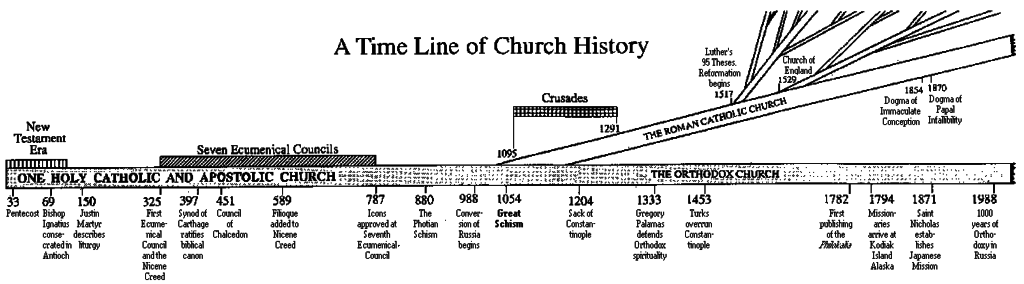
So, since we’re interested in the early church, let’s take a look at a high level timeline:

Now, on a timeline like this, “Early Christianity” looks pretty nebulous. What does that mean? The timeline above is a pretty typical layout used by Protestants. If you go to Catholic or Orthodox sources, it differs a bit:

Note that the different between getting this from a Orthodox perspective or a Catholic perspective will change whichever church continues on the straight line, and which one branches off.

The text is small, but note that the First Ecumenicial Council was in 325, and is where the Nicene creed was first developed (finalized at the Second Ecumenical council). The Biblical canon was established by the 5th century. All of this is happening during that nebulous period.

So why did it take almost 300 years from Pentecost to have a council to establish a creed? Did Christians just not know what they believed for 300 years? The real problem is that for 300 years the church was forced to largely operate underground in the Roman empire. The Church was able to establish itself somewhat even in the very early days we see recorded in the New Testament, but it wasn’t really until Constantine, the first emporer who was really friiendly to Christianity, came to power that they were able to operate more freely. Note that I’m not a historian and even with that caveat, I’ve only got a high level view of the history of this era, and I may be simplifying this. Nonetheless, all the Church structure that many Protestants don’t seem to like, such as Bishops and Patriarchs, etc, were all pretty much established in the first 500 years. A lot of Protestants object to “priests”, but that title was in use by the 2nd century.

All of this is really just to say that there was a real and unified Church during this time period. Yes, there were heresies, and there were some schisms, but the Church was largely united up until 1054 AD (though the seeds of this had probably been in place for awhile before it officially happened).

Here’s this relatively short but helpful video (Made by a Catholic, but it seems to me like it’s a pretty fair treatment)

There’s plenty more to be learned about the Great Schism, but, I’ll suffice it to say that in my opinion it seems to me that the Bishop of Rome was the one who forced the split, and that it was largely because of his insistence that he should have more power. And I do think that Catholics seem to have added a great deal to the faith – and that those were in part things that led to the Reformers wanting reform, and also in part things that forced further schism as how do you argue against Papal supremacy from within? If one guy has all the power, how do you affect change?

I think that Protestantism was probably the logical end of Roman Catholocism, and I think that the endless denominations and non-denominatiions of Protestantism is the logical end of Protestantism. And I don’t think it’s a good end, because the prayer of Jesus was:


“I do not pray for these alone, but also for those who will believe in Me through their word; that they all may be one, as You, Father, are in Me, and I in You; that they also may be one in Us, that the world may believe that You sent Me.  And the glory which You gave Me I have given them, that they may be one just as We are one:  I in them, and You in Me; that they may be made perfect in one, and that the world may know that You have sent Me, and have loved them as You have loved Me.”

John 17:20-23

Christians are hopelessly divided, and that almost entirely comes from the seeds of the Reformation. The Reformation still strikes me as being necessary, and yet, the consequences are very dire.

All that being the case, it seems to me there is a very strong case that the Orthodox church is, as they would say, the fullness of the faith. That it has continued unbroken and in unity since the beginning of the faith. And so, I’m deciding to give Orthodoxy a try. I almost want to use stronger language than that, but I’ll be honest, I’m still in the early days of entering it… I’ve only been into an Orthodox church one time so far, after all.